Video wall price: what an LCD video wall really costs
Video wall price depends on panel size, bezel width, controller, mounting, and commissioning. See what drives LCD video wall cost for integrators.
Published 2026-09-23
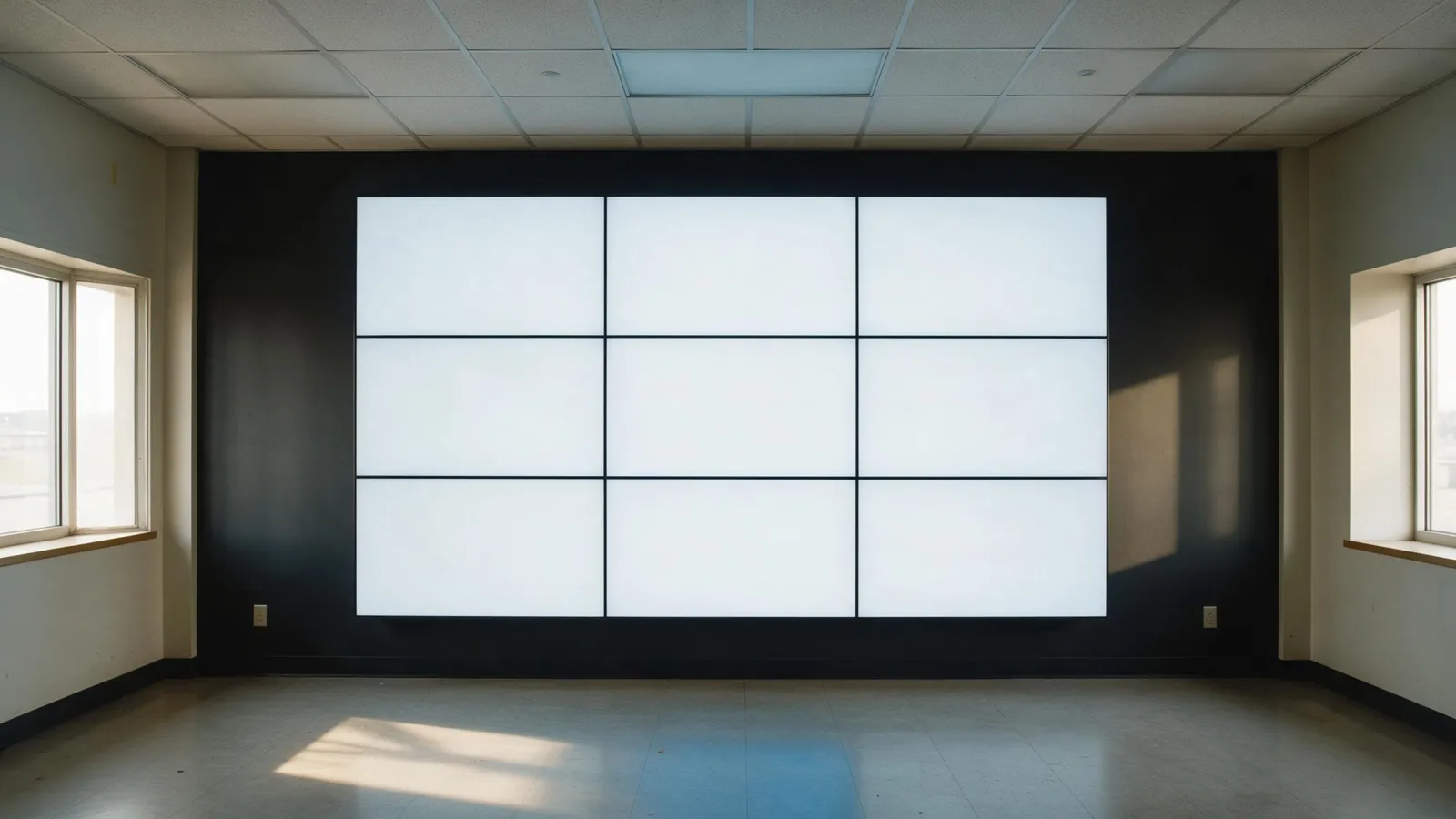
Video wall price isn't one number. It's the sum of panels, bezel width, controller, mounting, cabling, commissioning, and spares. Here's how to budget it. See our digital signage displays for the specifications.
What drives LCD video wall price per panel
Panel size is the first driver. We offer LCD video wall panels in 46, 49, 55, and 65 inch. Bigger panels cost more per unit, but you need fewer of them for a given wall area. The real cost driver is the splicing seam. Our catalogue lists a seam range from 0.88 to 3.5 mm. That's the gap between active image areas when panels sit side by side. A narrower seam means less interruption in the picture. It also means a higher per-panel price. The 0.88 mm option costs more than the 3.5 mm option because the manufacturing tolerances are tighter. A buyer who wants a near-continuous image in a control room will pay for the narrower seam. A buyer in a retail space where viewers are farther away can often use the wider seam and save money.
Viewing angle matters too. Our video wall panels have a 178 degree viewing angle. That's wide enough for most lobbies and command centers. It doesn't change the price by itself, but it tells you the image won't wash out when people stand off to the side.
Don't confuse LCD video wall price with LED wall price. LED walls are built from modules and have no seams, but they cost differently and aren't in our catalogue. We'll compare them later.
Controller and signal distribution costs
You can't just plug four HDMI cables into four panels and call it a wall. You need a splicing processor or a controller. Traditional video wall controllers often cost up to $50,000 or even $100,000, and are often complex to order and integrate, according to Digital Signage Today. That's for high-end systems. But the same source says purchasing a video wall controller won't blow your project budget and can save you money by reducing the cost of your displays. So the controller is a line item you must plan for. A simple 2x2 wall may run on a lower-cost processor. A 4x4 wall with multiple inputs and windowing needs more horsepower.
Signal distribution adds cost. You'll need HDMI or DisplayPort cables, possibly extenders, and a way to loop the signal from one panel to the next. Our panels support loop-through, which reduces the number of source outputs you need. But you still have to buy the cables, and long runs may need active extenders or HDBaseT. Count that per panel.
Mounting systems and installation methods
We list six installation methods for our LCD video walls: wall mount, pre-maintenance, cabinet, floor stand, arc, and shaped. Each one changes the video wall cost.
- Wall mount: the lowest hardware cost, but the wall must be strong enough. You pay for brackets and possibly structural reinforcement.
- Pre-maintenance bracket: a hinged mount that lets you swing a panel out for service. It costs more than a fixed wall mount, but it saves labor later.
- Cabinet: a freestanding or wall-mounted enclosure. It hides cables and looks cleaner. It adds material and assembly cost.
- Floor stand: no wall work, but you pay for the stand and floor space. Good for temporary or movable walls.
- Arc: curved wall. You need custom brackets and careful alignment. That's more labor.
- Shaped: non-rectangular layouts like columns or creative mosaics. The mounting hardware is often custom, and commissioning takes longer.
Structural requirements matter. A wall mount on drywall isn't the same as a wall mount on concrete. You may need an engineer to sign off. That's a soft cost, but it's real.
Commissioning, calibration, and spares
Commissioning is the step people forget. You have to align the panels, adjust color and brightness so they match, and configure the controller. A poorly calibrated wall looks like four separate screens. A good integrator will charge for this time. It's not a fixed number; it scales with wall size and complexity.
Spare panel strategy is part of video wall price. If one panel fails in a 3x3 wall, you have a hole. Keep a spare panel or at least a plan to get one fast. Some buyers buy an extra panel up front. That adds cost now but saves downtime later. Ask any supplier about lead time for replacement panels.
Maintenance is ongoing. Dust, heat, and 24/7 operation wear on panels. Front-access panels from some vendors make service easier, but that's a feature to verify with the supplier, not something we state for our catalogue.
LCD video wall vs LED wall: seam, viewing distance, serviceability
Seam is the big difference. LCD video walls have visible seams in the 0.88 to 3.5 mm range, depending on the panel. LED walls have no seams because they're built from small modules. But LED walls have a pixel pitch that determines minimum viewing distance. Our catalogue doesn't list pixel pitch for LED because we don't sell LED walls. So we compare qualitatively.
Viewing distance: LCD suits closer viewing. A 0.88 mm seam is fine for a control room where operators sit a few feet away. LED walls are better for farther viewing, like a stage backdrop or a building lobby ceiling. The pixel pitch on an LED wall determines how close you can stand before you see individual LEDs. For LCD, the seam is the limiting factor, not pixel pitch.
Serviceability: LED walls are usually front-serviceable. You replace a module, not the whole wall. LCD video walls can be front-serviceable too, but it depends on the mounting system. A pre-maintenance bracket makes front access easy. A fixed wall mount may require rear access, which is a problem if the wall backs onto another room. Ask your supplier how you'll replace a panel before you buy.
So which is cheaper? We can't quote LED prices because we don't sell LED. But for a given wall size, LCD often has a lower entry cost for indoor, close-viewing applications. LED wins when you need a huge, bright, uninterrupted canvas. The video wall sector reached a global market value of $6.4 billion, under-scoring a 47 percent year-on-year growth across three major video-wall technologies: rear projection cubes (RPC), LED, and LCD, according to AVNetwork. So both technologies have a place.
How to budget a video wall project
Panel cost is only part of the total. You have to add the controller, mounting hardware, cables, commissioning, and spares. A rule of thumb: panels are the biggest single line item, but the other costs can add up to more than you expect. Don't budget just for the screens.
Installation and commissioning costs vary by region and complexity. A simple wall mount in a ground-floor room is less than a shaped wall on a curved wall with custom brackets. Get quotes from local integrators.
Spares and contingency: set aside money for a spare panel or at least a fast replacement path. Also add a contingency for surprises like structural reinforcement or cable length changes. A buyer who skips contingency often ends up over budget.
Compare the options before you commit. Here's a quick table:
| Factor | LCD video wall | LED wall |
|---|---|---|
| Seam | Visible, 0.88 to 3.5 mm | No seam |
| Viewing distance | Suits closer viewing | Suits farther viewing |
| Serviceability | Depends on mount; front access possible | Usually front-serviceable modules |
| Entry cost for indoor, close viewing | Often lower | Often higher |
| Brightness for high ambient light | Varies by panel | Can be very high |
Buyer checklist:
- Confirm panel size and quantity.
- Choose bezel width: 0.88 mm for close viewing, 3.5 mm for budget or distance.
- Specify the controller or splicing processor.
- Pick the mounting method and verify wall structure.
- Include cables, extenders, and signal distribution.
- Budget for commissioning and calibration.
- Plan for a spare panel.
- Ask any supplier for certificates, MOQ, warranty terms, and test reports.
We publish the video wall price drivers, not a fixed quote. Every project is different. Send us your model or size, quantity, target market, and any customisation. We'll reply with a quote and lead time. Our office is at RM1405, Block A, Xichuang Technology Building, No.7025 Liuxian Avenue, Xili Street, Nanshan District, Shenzhen. Use the contact page to start.
Sources
Frequently asked
How much does a video wall screen cost?
Video wall screen cost depends on panel size, bezel width, and quantity. A 55 inch LCD panel with a 0.88 mm seam costs more than a 46 inch panel with a 3.5 mm seam. You also need a controller, mounting, and commissioning. Ask any supplier for a quote based on your wall size and installation method.
How much is a 200 inch video wall?
A 200 inch video wall is a large format. You'd build it from multiple LCD panels, like a 3x3 or 4x4 array of 55 inch panels, or use an LED wall. We don't quote LED prices. For LCD, the cost is the sum of panels, bezel width, controller, mounting, and spares. Send us the wall dimensions and we'll spec it.
How much does a Just video wall cost?
We can't speak for other brands. 'Just' isn't a brand we carry. Our LCD video wall panels come in 46, 49, 55, and 65 inch with seams from 0.88 to 3.5 mm. The total cost includes the controller, mounting system, cabling, and commissioning. Request a quote with your size and quantity.
How much does it cost to hire a video wall?
Hiring a video wall is different from buying one. Rental costs depend on wall size, duration, installation, and whether you need an operator. We sell hardware, not rentals. For a permanent install, buying often makes sense after a few events. Ask rental companies for their day rates and setup fees.
Request a quote
Send the model, size and quantity you are quoting. You get a spec sheet and a price back within 24 hours.
- Lead time
- Bulk orders in as little as 15 days
- Build options
- OEM and ODM
- Support
- 24/7 technical and customer support